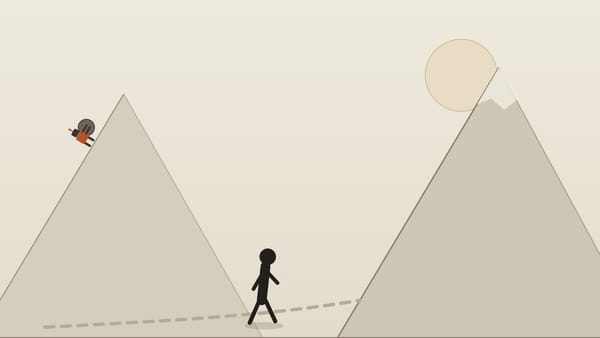
The Either/Or Trap — And How to Escape It
Breaking free from false binaries and discovering the possibilities that lie beyond either/or thinking
When Everything Becomes Either/Or
"Marry, and you will regret it. Don't marry, and you will also regret it. Marry or don't marry, you will regret it either way. Whether you marry or you don't, you will regret it either way."
— Søren Kierkegaard, Either/Or (1843) Contents
Preface
It is a Tuesday morning. You are staring at two job offers. One pays more. The other excites you more. You weigh them for days. You finally choose. And then, almost immediately, a quiet voice starts: "But what if the other one...?"
Now imagine that same Tuesday morning but instead of two job offers, you have fourteen. Eight are on LinkedIn. Three came through your network. Two are from companies you have never heard of, found through an app that learned your preferences. And there is one freelance path that does not fit any category at all.
This is not a hypothetical. This is the modern condition of choice. Kierkegaard had an Either/Or problem. We have an Everything/Or problem.
The Danish philosopher Søren Kierkegaard diagnosed the wound of choice nearly two centuries ago. He warned that we are trapped inside it, no matter which way we go. What he could not have imagined was that the wound would multiply — that the problem would not be choosing between two difficult paths, but choosing between hundreds of paths, all arriving simultaneously, all demanding a decision right now.
The good news? Modern decision science — particularly the field of Multi-Criteria Decision Making (MCDM) — has developed precise, practical tools to navigate both the ancient Either/Or trap and its modern cousin, choice overload. Not to eliminate regret entirely, but to make decisions we can actually stand behind.
Part One
Kierkegaard's Uncomfortable Gift
Søren Kierkegaard (1813–1855) was a philosopher who spent his life making people uncomfortable with their own lives. In Either/Or (1843), he presented a radical idea: You will regret it either way.
He was not being cynical. He was pointing to something deeply real: every choice we make simultaneously closes off another possibility. When you choose A, you lose B — not just in practice, but in imagination. And imagination, as any anxious mind knows, is merciless.
Kierkegaard described three stages of human existence:
| Stage | What Drives You | The Problem |
|---|---|---|
| Aesthetic | Pleasure, variety, novelty | You leap from option to option, never committing |
| Ethical | Duty, rules, social expectation | You choose what is "right" but not what is yours |
| Religious | Committed, courageous self-choice | You make the leap — fully, personally, irreversibly |
For Kierkegaard, the tragedy was not making wrong choices. The tragedy is making choices at all — because choice implies loss. The only exit is what he called the "leap of faith": a total, committed choice made not from certainty, but from courage and self-knowledge.
In plain words: You choose Noodle at a restaurant. The pasta looks delicious. You taste your Noodle — it is good. But your eye keeps drifting to your neighbour's plate. What if...? This is Kierkegaard's Either/Or over lunch. Multiply it across careers, partnerships, and investments — and you understand the existential weight he was describing.
Part Two
From Either/Or to Everything/Or — The Modern Choice Overload
Kierkegaard lived in 19th-century Copenhagen. His world was local, slow, and bounded. A person might choose between two or three careers in a lifetime. Marriage had a small social pool. The news arrived by post. The options, while still agonising to choose between, were countable.
That world is gone.
The Numbers Tell the Story
Consider what the modern decision-maker faces every day:
| Domain | Kierkegaard's Era (c. 1843) | Today |
|---|---|---|
| Career options | ~5–10 occupations accessible | 700+ recognised professions; freelance platforms list 500+ skill categories |
| Life partners | Village/community pool; arranged introductions | Dating apps expose users to thousands of profiles per week |
| Consumer products | Local shop, few brands | An average supermarket stocks 30,000–50,000 SKUs [8] |
| Investment choices | Land, gold, government bonds | 10,000+ mutual funds in India alone; thousands of stocks, crypto assets, REITs |
| Information sources | One newspaper, one preacher | 500+ hours of video uploaded to YouTube every minute |
| Healthcare decisions | One doctor, one remedy | Patients arrive with hundreds of Google results and conflicting advice |
The philosopher was right that choice causes regret. He could not have known that choice would also cause paralysis.
The Paradox of Choice
Psychologist Barry Schwartz described this phenomenon in his landmark 2004 book The Paradox of Choice.[8] His central, counter-intuitive finding: more options do not make us more free or more satisfied. They make us more anxious, more likely to regret, and less likely to decide at all.
Schwartz identified two personality types in the face of choice: Maximiser vs Satisficer
Maximiser : Maximiser Surveys every option Seeks the absolute best .
Outcome: Chronically dissatisfied — there is always something better they did not choose.
Satisficer: Sets a threshold; picks the first option that meets it.
Outcome: Happier overall — good enough, chosen confidently, moved on.
The cruel irony of the modern world is that it turns satisficers into maximisers by force. When options are few, settling is easy. When options are infinite, the fear that you settled haunts you. The internet has made maximisers of all of us — presenting comparison tables, review aggregators, and "people also considered" lists that make every decision feel incomplete.
Decision Fatigue — The Hidden Cost
The cognitive load of too many choices has a clinical name: decision fatigue. Research by Roy Baumeister and colleagues shows that the quality of human decisions deteriorates sharply after sustained periods of choosing. This is why:
1- Judges grant more lenient paroles in the morning than in the afternoon.
2- Doctors prescribe more default treatments as the clinic day wears on
3- Consumers buy more impulsively at the end of a shopping trip
In the modern world, by the time you face your most important decisions of the day, you have often already spent your cognitive budget on dozens of trivial ones — which streaming show to watch, which commute route to take, which email to answer first.
The Either/Or problem Kierkegaard described assumed two paths. The modern problem is not two paths — it is a forest with no paths at all, only options stretching to the horizon, each looking equally plausible, equally regrettable.
Part Three
The Science of Regret — Kierkegaard Was Right
Behavioural economists have since confirmed what Kierkegaard suspected. Daniel Kahneman and Amos Tversky demonstrated through Prospect Theory (1979) that we do not experience gains and losses symmetrically.[1] Losses hurt approximately twice as much as equivalent gains feel good. The path not taken looms larger in our minds than it deserves.
Research identifies two types of regret:
| Type | What It Is | How It Fades |
|---|---|---|
| Regret of Action | You did something; it went wrong | Fades over time — we rationalise: "At least I tried" |
| Regret of Inaction | You did not act; you wonder forever | Grows over time — imagination fills the blank with gold |
Thomas Gilovich and Victoria Medvec (1995) found in a landmark study that in the long run, people regret inaction more than action. We regret the businesses we never started, the conversations we never had, the roads we never took — far more than the ones we did and stumbled on.
The Regret Landscape — Four Scenarios
| You Acted | You Did Not Act | |
|---|---|---|
| Outcome was good | Relief, pride, satisfaction | Mild relief — but could I have done even better? |
| Outcome was poor | Sharp regret — fades as you rationalise | Slow, lingering regret — grows as imagination fills the void |
| Outcome uncertain | Anxiety, but also agency | Permanent uncertainty — you will never know |
The Core Paradox: We regret acting when things go wrong, and we regret not acting when things go right for others. There is no regret-free zone. The only question is: which kind of regret can you live with better?
Part Four
What is MCDM — and Why Does It Help?
Multi-Criteria Decision Making (MCDM) is a branch of operations research and management science that provides structured methods for making choices when multiple, often conflicting, criteria must be considered simultaneously. It was developed to solve exactly the problem described in Part Two: too many options, too many criteria, too much cognitive load for unaided human judgment.
Most decisions feel paralysing because we are trying to optimise for everything at once, in our heads, without structure. MCDM gives that chaos a skeleton. It does four things that unaided human judgment cannot:
1-Externalises Values
Forces you to name what matters and how much — making the invisible visible.
2-Prunes the Option Space
Gives you a principled way to eliminate options before the deep analysis begins, directly solving the overload problem.
3-Separates Analysis from Emotion
Lets you feel after you have thought — emotion informs the weights, not the calculation.
4- Creates a Defensible Record
If the outcome is poor, you can look back and say: "I made the best decision with the information and values I had at the time."
We will walk through three MCDM tools with worked templates you can use immediately.
MCDM Tool 1
The Weighted Scorecard
What It Is
The simplest and most widely used MCDM method. You list your options, name your criteria, assign weights based on their importance to you, score each option against each criterion, and compute a weighted total. The highest score wins — but more importantly, you have made your values explicit.
The magic is not the final number. It is the conversation you have with yourself while filling it out.
Weighted Scorecard — Process Flow List Options Define Criteria and Weights Score Each Option 1-5 Multiply Scorex Weight Highest Total= Recommendation
Step-by-Step
1-List all realistic options (rows)
2-List all criteria that matter to you (columns)
3-Assign a weight to each criterion (must add up to 100%)
4-Score each option on each criterion (1 = very poor, 5 = excellent)
5-Multiply each score by its criterion weight
6-Sum across all criteria for each option
7-The option with the highest weighted total is your analytical recommendation
Template — Career Choice Example
Scenario: You are choosing between three job offers.
Step 1: Define Criteria and Weights
| Criterion | Weight |
|---|---|
| Salary & Benefits | 25% |
| Growth Potential | 30% |
| Work-Life Balance | 20% |
| Alignment with Values | 15% |
| Location / Commute | 10% |
| Total | 100% |
Step 2: Score Each Option (1–5 scale)
| Option | Salary (25%) | Growth (30%) | WLB (20%) | Values (15%) | Location (10%) |
|---|---|---|---|---|---|
| Job A — MNC, high pay | 5 | 3 | 2 | 3 | 4 |
| Job B — Startup, exciting | 2 | 5 | 3 | 5 | 3 |
| Job C — Government role | 3 | 2 | 5 | 4 | 5 |
Step 3: Compute Weighted Scores
| Option | Salary | Growth | WLB | Values | Location | Total |
|---|---|---|---|---|---|---|
| Job A | 5×0.25=1.25 | 3×0.30=0.90 | 2×0.20=0.40 | 3×0.15=0.45 | 4×0.10=0.40 | 3.40 |
| Job B | 2×0.25=0.50 | 5×0.30=1.50 | 3×0.20=0.60 | 5×0.15=0.75 | 3×0.10=0.30 | 3.65 ✓ |
| Job C | 3×0.25=0.75 | 2×0.30=0.60 | 5×0.20=1.00 | 4×0.15=0.60 | 5×0.10=0.50 | 3.45 |
Analytical Recommendation: Job B (Score 3.65)
Job A pays most but scores lowest overall because you weighted Growth and Values heavily. Job C has the best work-life balance but poor growth. Job B wins — not because it is perfect, but because it best matches your stated priorities.
If that result surprises you, it means your real priorities may differ from what you wrote down. That surprise is the most valuable output of this exercise.
MCDM Tool 2
TOPSIS
What It Is
TOPSIS — Technique for Order Preference by Similarity to Ideal Solution — was developed by Hwang and Yoon (1981).[4] It asks: imagine the perfect option — it scores best on every single criterion. Now imagine the worst option. Which of your real choices is closest to the ideal and farthest from the worst?
TOPSIS is more mathematically rigorous than the weighted scorecard and is widely used in engineering, supply chain management, healthcare resource allocation, and public policy. It handles situations with many options and criteria where simple scoring becomes insufficient.
TOPSIS Concept — Closeness to Ideal Real Options (n-D space) Normalise and Weight V+ Ideal Best V- Ideal Worst Calculate d+and d- distances Ci = d- / (d-+d+) Closer to 1 = Better Rank by Ci score
The Core Idea (Simply Explained)
Think of each option as a point in a multi-dimensional space, where each dimension is one criterion. TOPSIS calculates:
- The distance of each option from the Ideal Best (best score on every criterion)
- The distance of each option from the Ideal Worst (worst score on every criterion)
The "closeness coefficient" for each option = distance from worst ÷ (distance from worst + distance from best). The closer this coefficient is to 1, the better the option.
Step-by-Step
- Build the decision matrix (same as weighted scorecard)
- Normalise scores so different scales become comparable
- Apply weights to the normalised scores
- Identify the Ideal Best and Ideal Worst per criterion
- Calculate Euclidean distance from Ideal Best and Ideal Worst for each option
- Compute the closeness coefficient
- Rank options by closeness coefficient (higher = better)
Template — Infrastructure Project Selection
Scenario: A district administration must select one of three rural road projects to fund.
Step 1: Decision Matrix (raw scores)
| Project | Cost Efficiency | Connectivity Benefit | Environmental Impact | Implementation Ease | Communities Served |
|---|---|---|---|---|---|
| Project Alpha | 8 | 6 | 7 | 5 | 9 |
| Project Beta | 5 | 9 | 8 | 7 | 6 |
| Project Gamma | 7 | 7 | 5 | 9 | 7 |
Step 2: Assign Weights
| Criterion | Weight |
|---|---|
| Cost Efficiency | 0.20 |
| Connectivity Benefit | 0.30 |
| Environmental Impact | 0.15 |
| Implementation Ease | 0.15 |
| Communities Served | 0.20 |
Step 3: Normalise Each Column (Divide each value by the square root of the sum of squared values in that column)
| Project | Cost Eff. | Connectivity | Environment | Ease | Communities |
|---|---|---|---|---|---|
| Alpha | 0.699 | 0.476 | 0.569 | 0.373 | 0.741 |
| Beta | 0.437 | 0.714 | 0.650 | 0.523 | 0.494 |
| Gamma | 0.612 | 0.556 | 0.406 | 0.672 | 0.576 |
Step 4: Apply Weights → Weighted Normalised Matrix
| Project | Cost Eff. | Connectivity | Environment | Ease | Communities |
|---|---|---|---|---|---|
| Alpha | 0.140 | 0.143 | 0.085 | 0.056 | 0.148 |
| Beta | 0.087 | 0.214 | 0.098 | 0.078 | 0.099 |
| Gamma | 0.122 | 0.167 | 0.061 | 0.101 | 0.115 |
Step 5: Identify Ideal Best (V+) and Ideal Worst (V−)
| Cost Eff. | Connectivity | Environment | Ease | Communities | |
|---|---|---|---|---|---|
| V+ (Best) | 0.140 | 0.214 | 0.098 | 0.101 | 0.148 |
| V− (Worst) | 0.087 | 0.143 | 0.061 | 0.056 | 0.099 |
Step 6: Distances and Closeness Coefficient
| Project | Distance from V+ | Distance from V− | Closeness (Ci) | Rank |
|---|---|---|---|---|
| Alpha | 0.073 | 0.084 | 0.535 | 2nd |
| Beta | 0.075 | 0.078 | 0.510 | 3rd |
| Gamma | 0.065 | 0.068 | 0.511 | 1st ✓ |
Recommendation: Project Gamma
Despite not topping any single criterion, Gamma achieves the best overall balance between ideal and worst scenarios. Project Alpha has the highest community reach but scores low on implementation ease. Beta has the best connectivity but is costly.
Key TOPSIS insight: The winner is rarely the option that is best at one thing. It is the option that is most balanced across everything that matters. This directly counters Kierkegaard's regret trap — you are choosing the most complete solution, not a one-dimensional champion.
MCDM Tool 3
AHP — Analytic Hierarchy Process
What It Is
The Analytic Hierarchy Process was developed by mathematician Thomas L. Saaty at the University of Pittsburgh in 1977 and published formally in 1980. It is used by governments, the World Bank, multinational corporations, and military planners for strategic decisions. AHP is arguably the most sophisticated and widely validated of all MCDM methods.
AHP works through pairwise comparisons — instead of directly assigning weights (which is surprisingly difficult and inconsistent), you compare criteria two at a time: "Is Growth Potential more important than Salary? How much more — a little, moderately, or a lot?"
The genius of AHP is its Consistency Ratio (CR): it mathematically tests whether your preferences are logically consistent. If you say A>B, and B>C, but then say C>A — AHP catches this contradiction. It forces you to be coherent in your own values, which is harder than it sounds and enormously clarifying.
AHP Three-Level Hierarchy GOAL: Best Digital Transformation Strategy Cost Efficiency Citizen Impact Risk Level Adoption Ease Strategy A Centralised Cloud Strategy B Distributed Edge Strategy C Hybrid Phased (Winner)
Saaty's Comparison Scale
| Score | Meaning |
|---|---|
| 1 | Equal importance |
| 3 | Moderate importance of one over another |
| 5 | Strong importance |
| 7 | Very strong importance |
| 9 | Extreme importance |
| 2, 4, 6, 8 | Intermediate values between the above |
Reciprocals apply automatically: if A is rated 3 over B, then B is rated 1/3 over A.
Step-by-Step
1-Define goal, criteria, and options in a 3-level hierarchy
2-Build pairwise comparison matrices for criteria
3-Calculate priority weights from the matrices
4-Compute the Consistency Ratio (CR) — should be < 0.10
5-Synthesise: multiply option scores by criterion weights, sum for final ranking
Template — Policy Decision Example
Scenario: A government department must choose between three digital transformation strategies.
| Cost Efficiency | Citizen Impact | Risk Level | Adoption Ease | |
|---|---|---|---|---|
| Cost Efficiency | 1 | 1/3 | 3 | 1/5 |
| Citizen Impact | 3 | 1 | 5 | 1/2 |
| Risk Level | 1/3 | 1/5 | 1 | 1/7 |
| Adoption Ease | 5 | 2 | 7 | 1 |
Reading this table: Citizen Impact is rated 3× more important than Cost Efficiency. Adoption Ease is rated 5× more important than Cost Efficiency, and 7× more important than Risk Level.
Step 2: Compute Priority Weights (Normalise each column by its sum, then average across each row)
| Criterion | Column Sum | Normalised | Final Weight |
|---|---|---|---|
| Cost Efficiency | 9.33 | 0.107 | 10.7% |
| Citizen Impact | 3.53 | 0.282 | 28.2% |
| Risk Level | 16.00 | 0.063 | 6.3% |
| Adoption Ease | 1.84 | 0.548 | 54.8% |
Insight: This decision-maker implicitly values Adoption Ease most — 54.8%. This would be invisible without AHP's structured process.
Step 3: Score Each Strategy Against Each Criterion (1–9 scale)
| Strategy | Cost Efficiency | Citizen Impact | Risk Level | Adoption Ease |
|---|---|---|---|---|
| Strategy A — Centralised Cloud | 7 | 6 | 4 | 5 |
| Strategy B — Distributed Edge | 5 | 8 | 6 | 6 |
| Strategy C — Hybrid Phased | 6 | 7 | 8 | 8 |
Step 4: Compute Final Scores
| Strategy | Cost (10.7%) | Impact (28.2%) | Risk (6.3%) | Adoption (54.8%) | Final Score |
|---|---|---|---|---|---|
| Strategy A | 7×0.107=0.749 | 6×0.282=1.692 | 4×0.063=0.252 | 5×0.548=2.740 | 5.433 |
| Strategy B | 5×0.107=0.535 | 8×0.282=2.256 | 6×0.063=0.378 | 6×0.548=3.288 | 6.457 |
| Strategy C | 6×0.107=0.642 | 7×0.282=1.974 | 8×0.063=0.504 | 8×0.548=4.384 | 7.504 ✓ |
Step 5: Consistency Check
AHP requires verifying that pairwise comparisons do not contradict each other. The Consistency Ratio (CR) should be below 0.10 (10%).
Recommendation: Strategy C — Hybrid Phased (Score 7.504)
Your pairwise comparisons are internally consistent. You are not saying "A > B > C > A" — your stated preferences form a coherent value hierarchy. The analysis can be trusted.
Key AHP insight: In everyday decisions, we routinely hold contradictory preferences without knowing it. AHP makes those contradictions visible — and forces you to resolve them before making the decision, not after.
Part Five
Regret Minimisation — The Bridge Between Philosophy and Method
Beyond the three structured tools above, there is a powerful intuitive framework that directly addresses Kierkegaard's regret problem. It was used by Jeff Bezos when deciding to leave a lucrative Wall Street career to start Amazon.
Project yourself forward to age 80, looking back on your life. From that vantage point, ask: "Which choice would I regret more — having tried and failed, or having never tried?"
— Jeff Bezos · The Regret Minimisation Framework
Formally, MCDM has a mathematical version called Min-Max Regret:
- For each option, calculate the maximum regret (the difference between what you got and what you could have gotten by choosing differently)
- Choose the option that minimises your maximum possible regret
Min-Max Regret — Process Flow All Options Listed Future States Boom / Stagnation/ Disruption Regret per Option-State Pair Best - Your Outcome Find MAX per Option Choose MIN of Max Regrets = Safest Choice
Regret Matrix Template
Scenario: Career pivot decision — Stay in current role vs. Start a venture vs. Pursue further education
| Option | Economy Booms | Stagnation | Disruption |
|---|---|---|---|
| Stay in Role | 0 (best here) | 20 (moderate regret) | 80 (high — disrupted anyway) |
| Start Venture | 40 (missed security) | 60 (venture fails) | 0 (best here — ahead of curve) |
| Further Education | 30 (delayed earnings) | 0 (best here — skill premium) | 30 (relevant skills acquired) |
Maximum regret per option:
| Option | Max Regret | Assessment |
|---|---|---|
| Stay in Role | 80 | High risk of deep regret |
| Start Venture | 60 | Significant but bounded |
| Further Education | 30 ✓ | Minimises maximum regret |
Recommendation Under Min-Max Regret
Pursue Further Education — not because it is the most exciting, but because no matter how the future unfolds, your maximum regret is contained. This is the conservative, robust choice. It will not always give you the best outcome — but it limits the worst-case disappointment, which is exactly what Kierkegaard's framework demands.
Part Six
A Practical Synthesis — The 6-Step Decision Protocol
All three tools can be combined into a single decision protocol for any significant choice. The protocol explicitly addresses the modern problem of choice overload with an upfront pruning step.
The 6-Step Decision Protocol Step 0: Prune First Apply non-negotiables and disqualifiers — reduce to max 7 options
Step 1: Name Your Values Define criteria BEFORE looking at options
Step 2: Weighted ScorecardQuick first pass — takes about 20 minutes
Step 3: TOPSIS If more than 4 options or complex trade-offs remain
Step 4: AHP High-stakes or group committee decisions
Step 5: Regret Minimisation TestCan you live with the worst-case scenario?Leap and Inhabit the Choice Fully — Kierkegaard's Religious Stage0
Prune First — The Modern Addition
Before doing any analysis, cut your option list down to a manageable size. Define two or three absolute requirements (non-negotiables) and one immediate disqualifier. Any option that fails a non-negotiable is removed. Do this quickly, without scoring.
Example: You have 12 job offers. Non-negotiables: minimum salary of ₹15 LPA, no relocation outside Uttarakhand, healthcare benefits. Disqualifier: organisations with known ethical violations. After this filter — 4 options remain. Now apply the Weighted Scorecard to those 4.
The human brain handles 4 to 7 options well in simultaneous comparison.[9] Above that, judgment degrades. The pruning step is not about settling — it is about protecting your cognitive capacity for the decision that actually matters.
1-Name Your Values (Before Looking at Options)
Write down your criteria before evaluating options. If you look at options first, your criteria will reverse-engineer to justify the option you already feel drawn to. Ask: What would I want any ideal solution to give me? What would disqualify an option entirely?
2-Use the Weighted Scorecard for a First Pass
For most personal decisions, the weighted scorecard is sufficient. It takes 20 minutes. It will either confirm your intuition (giving you confidence) or challenge it (giving you pause). Both outcomes are valuable.
3-Upgrade to TOPSIS if Trade-offs Are Still Complex
If after pruning you still have more than four options, or more than five criteria, the weighted scorecard becomes unreliable. Switch to TOPSIS for a mathematically sound ranking. TOPSIS is also your best tool when options are structurally very different from each other — when comparing apples and oranges is unavoidable.
4-Use AHP if the Decision Is High-Stakes and Shared
For decisions made by committees, organisations, or with major life consequences, AHP's pairwise comparison process and consistency check are worth the effort. It surfaces hidden disagreements about values among stakeholders before they become conflicts about options.
5-Apply the Regret Minimisation Test at the End
After all analysis, run the Regret Matrix. Ask: If the worst-case scenario unfolds for my chosen option, can I live with that? If the answer is yes — with full knowledge of the MCDM analysis behind you — you have made a decision you can own. Then, as Kierkegaard urged: leap, and inhabit the choice fully.
Conclusion
The Dignity of a Structured Choice
Kierkegaard's genius was in naming the wound honestly. Every choice involves loss. That is not a malfunction of the human condition — it is the price of being conscious, of caring about multiple things at once, of being genuinely alive to possibilities.
What Kierkegaard could not have anticipated was a world in which that wound would be inflicted not once, but hundreds of times a day. The modern decision-maker does not just face an Either/Or. They face an Everything/Or — an infinite scroll of possibilities, each one whispering that the others might have been better.
Modern decision science does not cure either wound. But it offers us something valuable: a way to stop the scroll deliberately, name what matters, and commit. When we use the Option Pruning Filter, we assert that our attention is finite and our values are not. When we use the Weighted Scorecard, we have externalised our values and been honest about trade-offs. When we run the Consistency Check in AHP, we have forced our own preferences to be coherent. When we apply Regret Minimisation, we have looked our future self in the eye and chosen what that person could live with.
The goal is not a life without regret. The goal is regret you can own — regret that says: "I chose, with my full self, with my real values, with the information I had at the time." That is not defeat. That is dignity.
Kierkegaard did not say we should avoid the Either/Or. He said we should choose — and then inhabit that choice fully, in what he called the Religious stage: a total, committed engagement with the life you have actually chosen, rather than mourning the one you did not.
The MCDM frameworks above make that commitment easier to reach — and harder to second-guess. In a world of infinite options, they are not a luxury. They are, perhaps, a necessity.
The Full Arc — From Kierkegaard to MCDM Kierkegaard Either/Or+ Regret Science of Regret Prospect Theory Paradox of Choice MCDM Toolkit Prune → Scorecard TOPSIS / AHP / Regret Min Owned Regret+ Dignity Leap with Confidence
Quick Reference — The MCDM Toolkit
| Tool | Best For | Key Strength | Limitation |
|---|---|---|---|
| Option Pruning Filter | Choice overload (5+ options) | Clears cognitive space; applies before any scoring | Requires clear non-negotiables upfront |
| Weighted Scorecard | Personal decisions, fast analysis | Simple, transparent, immediate | Subjective weights; no consistency check |
| TOPSIS | Complex trade-offs, many options | Mathematically rigorous; finds the balanced best | Requires normalisation; harder to explain intuitively |
| AHP | High-stakes, shared decisions | Pairwise comparison; consistency verification | Time-consuming; needs facilitator for groups |
| Regret Minimisation | Deep uncertainty | Directly addresses long-term psychological cost | Does not optimise expected value |
References and Citations
- [1] Kahneman, D., & Tversky, A. (1979). Prospect Theory: An Analysis of Decision under Risk. Econometrica, 47(2), 263–291. doi.org/10.2307/1914185
- [2] Gilovich, T., & Medvec, V. H. (1995). The Experience of Regret: What, When, and Why. Psychological Review, 102(2), 379–395. doi.org/10.1037/0033-295X.102.2.379
- [3] Köksalan, M. M., Wallenius, J., & Zionts, S. (2011). Multiple Criteria Decision Making: From Early History to the 21st Century. World Scientific Publishing.
- [4] Hwang, C. L., & Yoon, K. (1981). Multiple Attribute Decision Making: Methods and Applications. Springer-Verlag, Berlin. doi.org/10.1007/978-3-642-48318-9
- [5] Behzadian, M., Otaghsara, S. K., Yazdani, M., & Ignatius, J. (2012). A state-of-the-art survey of TOPSIS applications. Expert Systems with Applications, 39(17), 13051–13069. doi.org/10.1016/j.eswa.2012.05.056
- [6] Saaty, T. L. (1980). The Analytic Hierarchy Process: Planning, Priority Setting, Resource Allocation. McGraw-Hill, New York.
- [7] Vaidya, O. S., & Kumar, S. (2006). Analytic hierarchy process: An overview of applications. European Journal of Operational Research, 169(1), 1–29. doi.org/10.1016/j.ejor.2004.04.028
- [8] Schwartz, B. (2004). The Paradox of Choice: Why More Is Less. HarperCollins, New York. — Schwartz's research found that supermarkets typically stock 30,000–50,000 products; documents the inverse relationship between choice abundance and decision satisfaction.
- [9] Baumeister, R. F., Bratslavsky, E., Muraven, M., & Tice, D. M. (1998). Ego depletion: Is the active self a limited resource? Journal of Personality and Social Psychology, 74(5), 1252–1265. doi.org/10.1037/0022-3514.74.5.1252. Also informed by: Miller, G. A. (1956). The magical number seven, plus or minus two. Psychological Review, 63(2), 81–97.
Primary Philosophical Source
- Kierkegaard, S. (1843). Enten–Eller [Either/Or]. Translated by Howard V. Hong and Edna H. Hong (1987). Princeton University Press.
Further Reading
- Schwartz, B. (2004). The Paradox of Choice: Why More Is Less. HarperCollins. — Accessible and essential on why abundance of options reduces wellbeing.
- Bell, D. E. (1982). Regret in Decision Making under Uncertainty. Operations Research, 30(5), 961–981.
- Loomes, G., & Sugden, R. (1982). Regret Theory: An Alternative Theory of Rational Choice under Uncertainty. Economic Journal, 92(368), 805–824.
- Saaty, T. L. (2008). Decision making with the analytic hierarchy process. International Journal of Services Sciences, 1(1), 83–98.
- Zeleny, M. (1982). Multiple Criteria Decision Making. McGraw-Hill, New York. darkorange-squirrel-769791.hostingersite.com