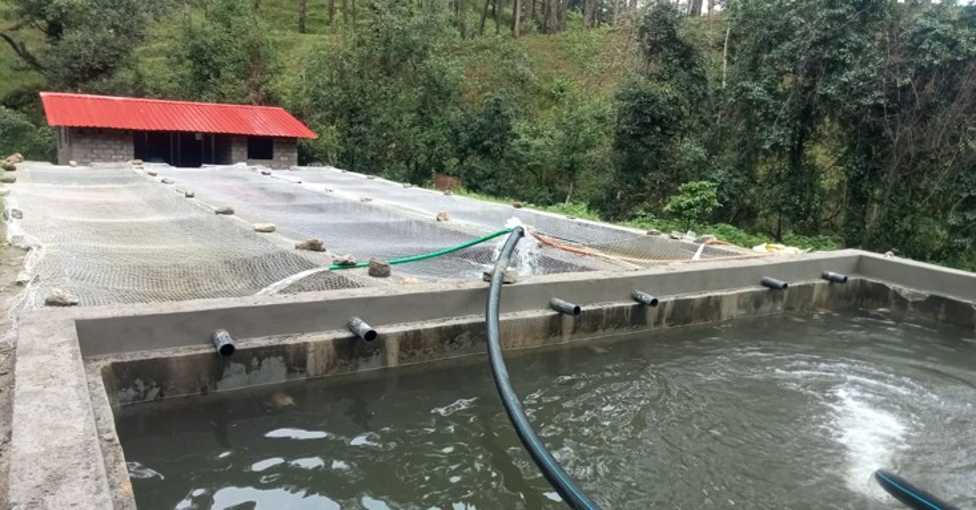
My Contribution and Impact under the Trout Protsahan Yojana
Promoting sustainable trout farming in Uttarakhand's hill districts through infrastructure support, employment generation and technology-enabled subsidy delivery
Scheme Name: Trout Prothsahan Yojna (Under FIDF scheme)
- Department/Directorate: Department of Fisheries, Uttarakhand
- Year of launch: FY 2025-26
- Government Order/Approval reference: 163/xv-3/2025-08(13)20254-E-FILE No 80654 dated 20-03-2025
- Geographical coverage: Uttarakhand (11 Hilly district of State)
- Status: Ongoing
Problem Addressed and Objective
· To enhance trout fish production by developing trout farming units.
· To construct trout seed production units to meet growing seed demand.
· To generate employment opportunities in hilly areas.
· Availability of protein rich fish source.
Scheme Design and Key Interventions
Target beneficiaries/Eligibility
(i) Fishers
(ii) Fish farmers
(iii) Fish workers and Fish vendors
(iv) Fisheries Development corporations
(v) Self Help Groups (SHGs)/Joint Liability Groups (JLGs) in fisheries sector
(vi) Fisheries cooperatives
(vii) Fisheries Federations
(viii) Entrepreneurs and private firms
(ix) Fish Farmers Producer Organizations/Companies (FFPOs/Cs)
(x) SCs/STs/Women
Institutional partners:
(i) District Fisheries Departments
(ii) NABARD
(iii) PNB/NPCI/RBI/ITDA (for CBDC based subsidy transfer)
Assistance
FIDF Rs. 133 crore; State share Rs.13 crore .
Subsidy
Integrated Raceway Unit / Hatchery Unit– All category beneficiaries- 70% of unit cost
Icebox, flex machine and deep freezer / Input - All category beneficiaries- 100% of unit cost
Service provided
Fish production and value chain development projects
Delivery mechanism
· The farmer submits the application along with all required documents through Apuni Sarkar Portal.
· Portal registers the application and forwards it to the concerned Assistant Director of Fisheries (ADF) Office.
· The concerned ADF Office scrutinizes the application and forwards it to the Block In-charge through Portal for field survey.
· The Block In-charge conducts the site survey, assesses the feasibility of the proposed activity, and submits the feasibility report to the ADF Office through Portal.
· Based on the survey report, and as per scheme guidelines, the ADF Office approves or rejects the application.
· In case of approval, the Approval Certificate is generated through Portal.
· The farmer receives the Approval Certificate through Portal.
· The subsidy is transferred in the form e-rupee (CBDC module)
Innovative Feature:
The scheme is implemented through CBDC module of subsidy transfer to beneficiaries.
Financial Outlay and Expenditure
· Total Project Cost: Rs. 177.00 Crore
· FIDF Loan sanctioned: Rs. 133.00 Crore
· State Share sanctioned: Rs. 13.00 Crore
· Funds Released: FY 2025-26/2026-27- Rs. 29.67 Crore
· Expenditure Incurred : FY 2025-26/2026-27- Rs. 11.95 Crore
· Fund Utilization: 40%
Physical Outputs
Project-wise status (2026-27):
|
Activities |
Target No. of Units |
Achievement |
|
Integrated raceways |
184 |
Ongoing |
|
Mini-hatcheries |
32 |
Ongoing |
|
Inputs |
216 |
Ongoing |
|
Cold storage
equipments /machineries |
184 |
Ongoing |
Total Beneficiary : 187
Employment and Livelihoods Generated
· Direct Employment: 357
· Indirect Employment: 1050
· Total Employment: 1407
Ground-Level Outcomes and Impact
The subsidy transfer mechanism through CBDC has made benefit delivery more transparent, efficient and accountable.
Implementation Challenges and Corrective Action
The Department of Fisheries has introduced a pioneering, technology-driven initiative by implementing the Trout Prohtsahan Yojna through the Central Bank Digital Currency (CBDC) mode. This initiative sets new benchmarks in transparency, efficiency, and accountability in subsidy delivery.
Present Status and Way Forward
Implementation of 184 integrated raceway units, 32 mini-hatcheries, 184 Cold storage equipments /machineries are under progress. It is target to complete all ongoing works by September 2026. Next physical and financial targets will be allocated in October 2026.
Success Stories of Trout Prothsahan Yojna
I. Implementation of ‘Trout Prohtsahan Yojna’ through CBDC Mode
• Trout Farming in Uttarakhand
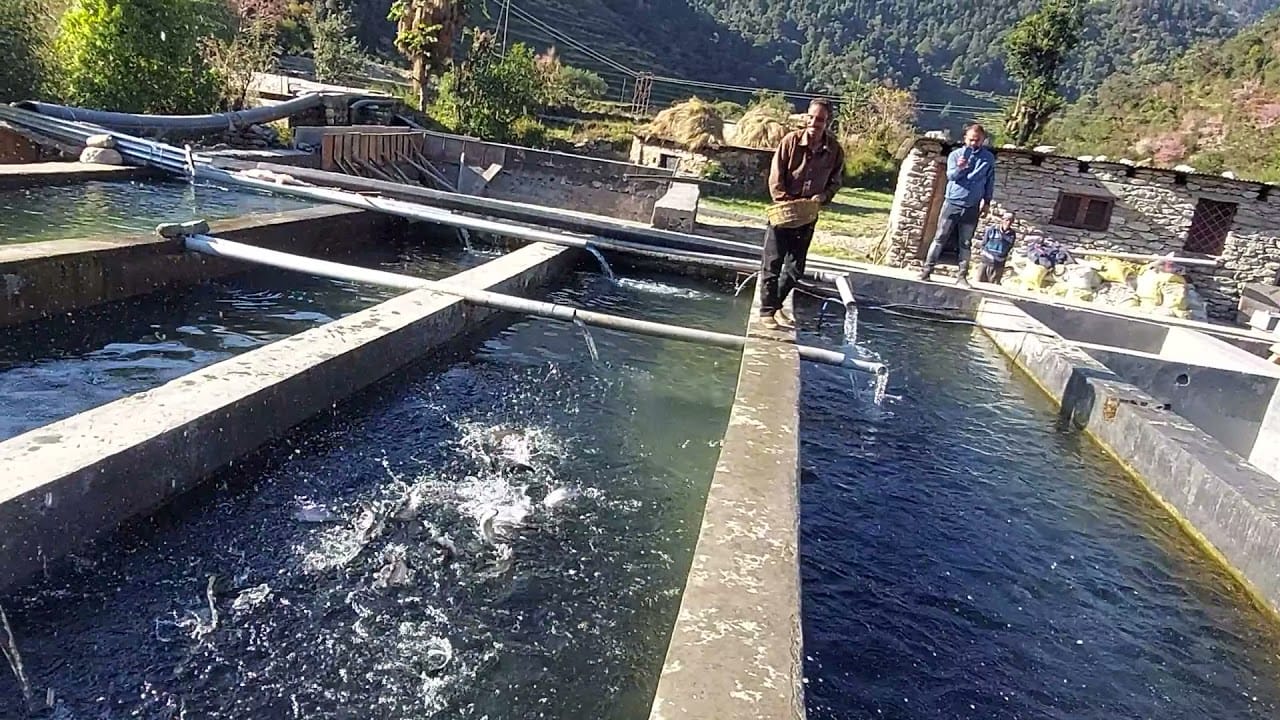
Trout farming is steadily emerging as a key livelihood activity in Uttarakhand, particularly in the state’s hilly and remote regions. The sector is currently providing direct livelihood support to around 300 farmer families, while also creating significant opportunities across the value chain.
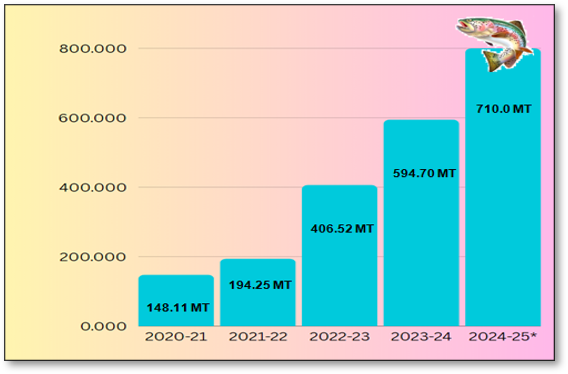
With targeted interventions from both the Central and State Governments, trout production in the state has witnessed remarkable growth from 148.11 metric tonnes in 2020–21 to 711 metric tonnes in 2024–25. This represents an impressive CAGR of approximately 48%, highlighting the rapid expansion and increasing importance of the sector.
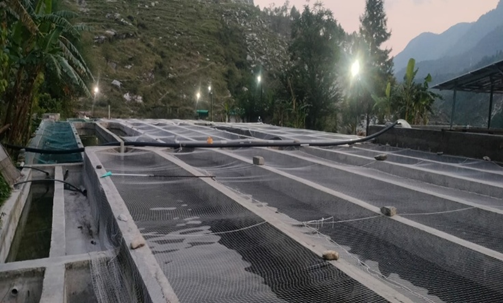
Over the years, substantial infrastructure has been developed to support this growth, including approximately 2,500 trout raceways, 10 hatcheries, and one brood bank. To strengthen post-harvest management and market access, 10 refrigerated vans (reefers) have been deployed for cold chain logistics and 5 processing plants are in the pipeline to further enhance post-harvest facilities.
On the marketing front, the state has established strategic tie-ups with institutions such as ITBP) and SSB, along with premium hotels. Branding and market positioning efforts are being carried out under the “Uttarafish” initiative, helping to create a distinct identity for trout from Uttarakhand.
Trout Farming in Uttarakhand
Trout farming is steadily emerging as a key livelihood activity in Uttarakhand, particularly in the state’s hilly and remote regions. The sector is currently providing direct livelihood support to around 500 farmer families, while also creating significant opportunities across the value chain.
Macro Growth Dynamics (2020–2026)
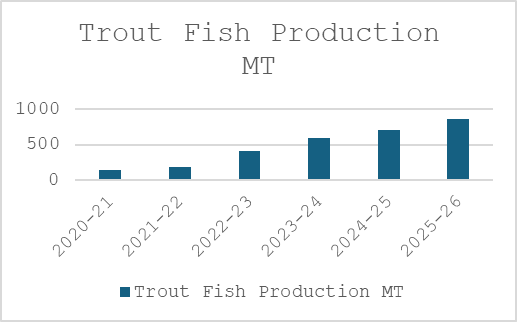
Driven by synchronized policy interventions from the Central and State Governments, the trout farming ecosystem has undergone a transition from localized husbandry to a structured commercial industry. Quantitative evaluation of annual production yields reveals an exponential expansion path.
- Baseline Output (FY 2020–21): 148.11 metric tonnes (MT).
- Terminal Output (FY 2025–26): 855.00 metric tonnes (MT).
- Compound Annual Growth Rate (CAGR): ~48%.
• Launch of Trout Prohtsahan Yojna and its Digital Implementation
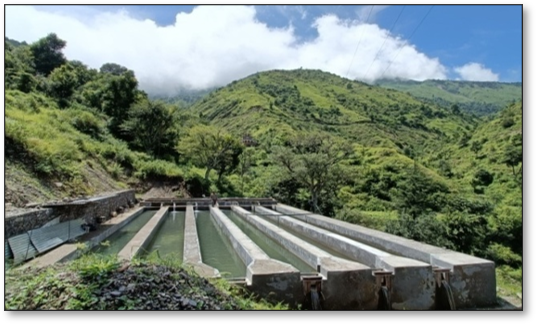
The Department of Fisheries has introduced a pioneering, technology-driven initiative by implementing the Trout Prohtsahan Yojna through the Central Bank Digital Currency (CBDC) mode. This initiative sets new benchmarks in transparency, efficiency, and accountability in subsidy delivery
Launched in 2025–26 with a total outlay of Rs. 170 crore, the scheme aims to promote trout farming as a sustainable and high-value livelihood, especially in remote and hilly regions.
Key Targets (2025–26 to 2028–29):
- 1,500 Trout Raceways
- 100 Mini Trout Hatcheries
- 600 Cold Storage Facilities
- Direct support to 600 beneficiaries
• Digital Implementation Framework
The scheme follows a fully digital, end-to-end process:
- Applications submitted via Apuni Sarkar Portal
- Multi-level verification at block & district levels
- Transparent beneficiary selection
Innovation in Digital Implementation- Programmable CBDC Subsidy Delivery
The program represents the first initiative in the fisheries sector to utilize CBDC for end-to-end subsidy transfers under the guidance of RBI, NPCI.
- End-to-End Workflow: Online applications via the Apuni Sarkar Portal leading to multi-level block and district verifications.
- Banking Partnership: Integrated directly with a custom platform developed by Punjab National Bank.
- Programmable Tokens: Monies are distributed as programmable digital tokens into beneficiaries' CBDC wallets.
- Controlled Spending: Funds are strictly restricted for approved purchases from pre-authorized vendors only.
- Phased Milestone Releases: Disbursements follow a strict 30:30:40 phase ratio explicitly tied to real-time physical progress.
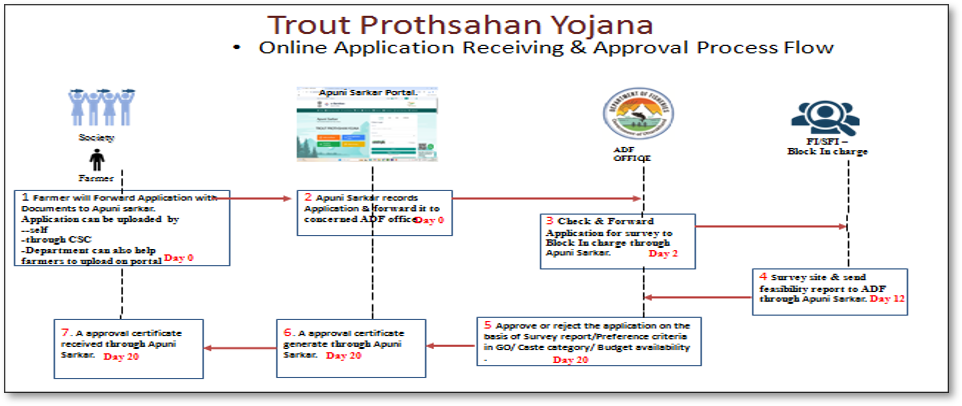
The verified data is integrated with a CBDC platform developed in collaboration with Punjab National Bank, ensuring seamless processing.
• CBDC-Based Subsidy Delivery (Innovation)
This is the first initiative in the fisheries sector to use Central Bank Digital Currency (CBDC) for subsidy transfer.
Key Features:
- Subsidy transferred as programmable digital tokens
- Credited directly into beneficiary CBDC wallets
- Usable only for approved purchases from authorized vendors
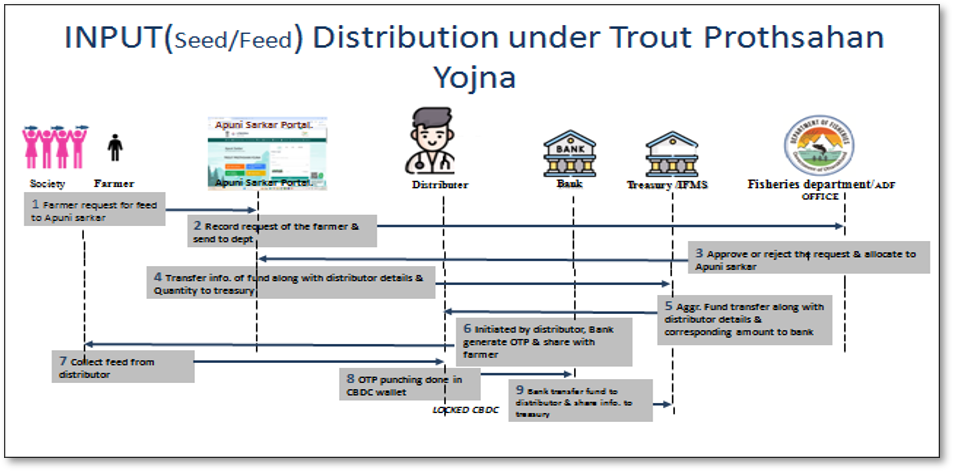
(Innovation) Programmable CBDC Subsidy Delivery
1. Application Ingestion (Day 0): Prospective fish farmers submit comprehensive digital applications, including land-tenure documents and geo-tagged site coordinates, via the unified Apuni Sarkar Portal by ITDA
- Multi-Level Verification (Day 2): Applications undergo automated administrative screening and cross-verification across block and district fisheries offices.
3. Technical Feasibility Assessment (Day 12): Field officers execute on-site technical surveys using mobile applications to verify perennial water access, water quality parameters, and physical land suitability.
4. Beneficiary Selection & Approval (Day 20): Validated applicants are selected through an automated, rules-based system. The system issues a digital approval certificate directly to the applicant's account, initiating the subsidy deployment sequence.
System Architecture and Financial Integration
The core innovation of the Trout Prohtsahan Yojna is its sovereign digital payment infrastructure. It is the first initiative within the fisheries sector to deliver public subsidies using a Central Bank Digital Currency (CBDC) architecture. This platform was developed through a technical collaboration with the RBI, NPCI, ITDA & Punjab National Bank (PNB). It interfaces the state's administrative approval registries directly with the central bank's digital currency ledger.
Token Programmability
Unlike traditional Direct Benefit Transfer (DBT) mechanisms that credit standard fiat currency into commercial bank accounts, this framework converts capital allocations into programmable digital tokens. These digital tokens are embedded with specific smart-contract criteria:
- Purpose-Locking: The tokens are cryptographically locked to ensure they can only be used for approved aquaculture inputs, such as certified trout seed, (fingerlings), specialized high-protein feed formulations, and standardized raceway construction materials.
- Vendor White-Listing: The tokens can only be transferred to the verified CBDC wallets of authorized vendors. This eliminates capital diversion into non-productive assets or informal cash economies.
Empirical Impact and Policy Outlook
Initial First-Year Outcomes
Empirical data from the initial rollout phase confirms the efficiency and speed of this programmable digital currency framework:
- Subsidies Disbursed: Rs. 6.42 crore successfully minted, programmed, and transferred through the CBDC system without any recorded leakages.
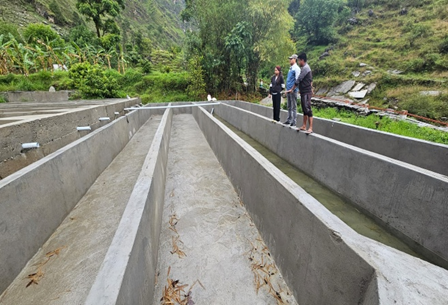
- Infrastructure Built: 171 trout raceways successfully constructed
- Hatchery Scaling: 30 mini-hatcheries completed, accelerating local fingerling production.
Transition to Smart Governance
The initial data demonstrates that this CBDC-driven approach delivers a scalable model for public financial management. By integrating smart-contract conditions directly into public welfare transfers, the scheme achieves three key policy outcomes:
- Optimal Capital Efficiency: Eliminates administrative delays and leakages, ensuring that public funds are directed exclusively toward building productive agricultural capital.
- Financial Inclusion for Farmers: Provides unbanked and under-banked rural farmers with secure access to formal digital financial tools, reducing their dependence on informal credit markets.
- Ecosystem Acceleration: Lowers transaction friction between farmers and input suppliers, stimulating investment and expanding the cold-water aquaculture economy.
This convergence of sovereign digital infrastructure with rural development policies sets a verified precedent for future tech-driven governance initiatives across agricultural sub-sectors.
• Phased Subsidy Release Mechanism
Subsidy is released in phases (30:30:40), linked with physical progress:
- Promotes timely execution
- Enables real-time monitoring
- Strengthens accountability
• Impact Achieved (2025–26)
- Rs. 6.42 crore subsidy disbursed via CBDC
- 171 Trout Raceways developed
- 30 Mini Hatcheries established
This demonstrates the efficiency and scalability of the CBDC-based model.
• Outcome & Way Forward
This initiative represents a shift towards smart governance in fisheries, ensuring:
- Efficient utilization of public funds
- Empowerment of farmers
- Growth of trout farming ecosystem