My Transformative Impact for the Pradhan Mantri Matsya Sampada Yojana (PMMSY)
Promoting sustainable fisheries through modern infrastructure, value chain development, employment generation and enhanced incomes for fishers across Uttarakhand
Scheme Name: Pradhan Mantri Matsya Sampada Yojana (PMMSY)
- Department/Directorate: Department of Fisheries, Uttarakhand
- Year of launch: FY 2020-21
- Government Order/Approval reference: GOI No.- 1071235/1/2020-Fy, dated 7th December 2020
- Geographical coverage: Uttarakhand (state-wide implementation)
- Status: Ongoing; overall project completion at 67% (22 of 33 sanctioned projects completed, 11 ongoing)
Problem Addressed and Objective
(a) Harnessing of fisheries potential in a sustainable, responsible, inclusive and equitable manner
(b) Enhancing of fish production and productivity through expansion, intensification, diversification and productive utilization of land and water
(c) Modernizing and strengthening of value chain - post-harvest management and quality improvement
(d) Doubling fishers and fish farmers incomes and generation of employment
(e) Enhancing contribution to Agriculture GVA and exports
(f) Social, physical and economic security for fishers and fish farmers.
Scheme Design and Key Interventions
Target beneficiaries/Eligibility:
(i) Fishers
(ii) Fish farmers
(iii) Fish workers and Fish vendors
(iv) Fisheries Development corporations
(v) Self Help Groups (SHGs)/Joint Liability Groups (JLGs) in fisheries sector
(vi) Fisheries cooperatives
(vii) Fisheries Federations
(viii) Entrepreneurs and private firms
(ix) Fish Farmers Producer Organizations/Companies (FFPOs/Cs)
(x) SCs/STs/Women/Differently abled persons
(xi) State Governments/UTs and their entities including
(xii) State Fisheries Development Boards (SFDB)
Institutional partners:
(i) Central Government and its entities including National Fisheries Development Board
(ii) State/UT Governments and their entities
(iii) State Fisheries Development Boards
(iv) Any other End Implementing Agencies as decided by Department of Fisheries
Assistance:
The North Eastern & the Himalayan States: 90% Central share and 10% State share.
Subsidy:
General category : 40% of unit cost, Women, SC/ST: 60% of unit cost, State Government: 90% of unit cost
Service provided:
Fish production and value chain development projects
Delivery mechanism:
(i) District Level Committee (DLC): Headed by the District Collector/Deputy Commissioner, responsible for preparation and approval of the Annual District Fisheries Plan and monitoring PMMSY implementation at the district level.
(ii) State Level Approval and Monitoring Committee (SLAMC): Headed by the senior-most Secretary of the State Fisheries Department, responsible for consolidating district plans, approving the State Annual Action Plan and projects as per PMMSY guidelines, and recommending them for funding.
(iii) Project Appraisal Committee (PAC): Constituted by the Department of Fisheries, Government of India, and headed by the Chief Executive, NFDB, to appraise State/UT proposals approved by the SLAMC under the Centrally Sponsored Scheme.
Innovative Feature of scheme:
The PMMSY is designed to address critical gaps in fish production and productivity, quality, technology, post-harvest infrastructure and management, modernization and strengthening of value chain, traceability, establishing a robust fisheries management framework and fishers’ welfare.
Financial Outlay and Expenditure
● Approved Outlay: Rs. 318.53Crore
● Central Share sanctioned: Rs. 171.48 Crore
● State Share sanctioned: Rs. 18.91 Crore
● Central Funds Released: Rs. 167.96 Crore
● Expenditure Incurred : Rs. 154.98 Crore
● Fund Utilization: 92.27% of total funds released
Physical Outputs
Project-wise status :
● Beneficiary Projects: 29 sanctioned, 22 completed, 7 ongoing (76% complete)
● Non-Beneficiary Projects (Integrated Aqua Park, Wholesale Fish Market, Landing Center, Promotion of Domestic Market): 4 sanctioned, 0 completed, 4 ongoing (under active implementation)
● Total: 33 sanctioned, 22 completed, 11 ongoing (67% complete)
Major Infrastructure created under PMMSY:
● Fish Production Infrastructure — 2,388 Raceways; 265.05 ha Ponds developed; 47.19 Lakh Fingerlings stocked in reservoirs
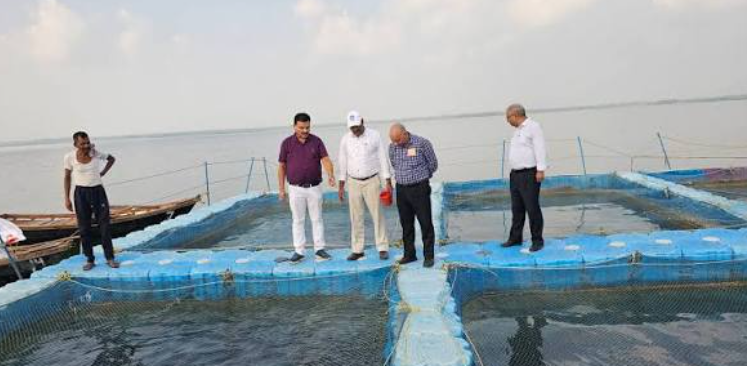
● Intensive Aquaculture Units — 183 Biofloc Units; 71 RAS Units; 200 Cage Units
● Seed, Feed & Marketing — 7 Hatcheries; 7 Fish Feed Mills; 126 Fish Kiosks
● Cold-chain Infrastructure- 01 Ice Plants & 01 Cold Storage units; 11 Refrigerated Transport units
● Large Infrastructure : 01 Integrated Aqua Park; 01 Wholesale Fish Market; 01 Landing Center.
Employment and Livelihoods Generated
● Direct Employment: 2,860
● Indirect Employment: 13,590
● Total Employment: 15,450
Ground-Level Outcomes and Impact
Fish production growth (2020-21 to 2025-26):
● 2020-21: 5,367 MT, 2021-22: 6,090 MT , 2022-23: 7,325 MT , 2023-24: 8,908 MT , 2024-25: 10,487 MT , 2025-26: 11,805 MT
● CAGR: 17.1% over 2020-21 to 2025-26
Baseline (2020-21): 5,367 MT; Latest (2025-26): 11,805 MT — production more than doubled over the five-year period.
Implementation Challenges and Corrective Action
(i) Release & Utilization of Funds
Challenges Faced:
Under the SNA mechanism, funds were released in four installments. However, delays and out-of-sequence release of installments have led to pending projects, as funds for subsequent years were received before the complete release of funds for earlier years.
Corrective Action Adopted:
The Department adopted a priority-based approach by utilizing available funds first to complete pending projects from previous years. New projects are taken up only after substantial completion of backlog works, ensuring efficient fund utilization and timely project implementation.
(ii) Technical Support for Integrated Aquapark Project
Challenges Faced:
Certain components of the sanctioned Aquapark project, including fish processing units and a Tilapia Hatchery, were being implemented in the State for the first time. Limited in-house technical expertise led to delays in project grounding and implementation.
Corrective Action Adopted:
The Department engaged expert organizations for technical consultancy. ICAR-CIFT and MPEDA provided support for establishing export-oriented fish processing units, while RGCA was engaged for setting up a satellite centre of the GIFT Tilapia programme. This strengthened technical planning and facilitated effective implementation of these specialized projects.
Present Status and Way Forward
· Current status: 67% of sanctioned PMMSY projects completed (22 of 33); 100% utilization of Central funds released till FY 2025-26; fund flow ongoing with a new Mother Sanction of Rs. 11.92 Crore (May 2026).
· Integrated Aqua Park, Sitarganj is targeted for completion by October 2026 (currently at 65% overall progress).
· Committed liabilities of Rs.15.44 Crore are targeted for 100% physical and financial completion by September 2026, with Utilization Certificate submission by the same month.
Success Stories of PMMSY
Perishable Harvest to a Distant Market
For fish farmers in the hilly areas of the state, producing fish was only half the challenge. There were no organized fish markets, cold storage facilities, or reliable transport systems in most of these areas. As a result, farmers had very few options. They often had to sell their fish to the first trader who came to their farm, accepting whatever price was offered. Since they could not store or transport their harvest, they had little bargaining power. This led to distress sales and discouraged many farmers from expanding fish farming.
Consumers in towns and cities also faced the impact. Fresh fish from the hills was rarely available, and whatever reached the markets often travelled through unorganized transport without proper cooling, affecting its freshness and quality.
PMMSY: Transforming the Fish Marketing
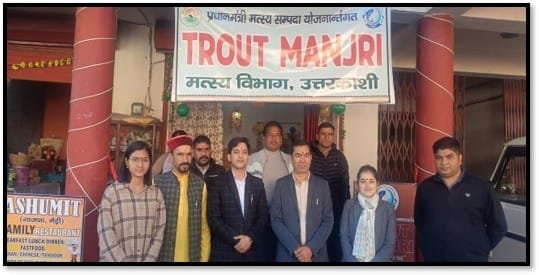
The PMMSY has transformed fish marketing in Uttarakhand by building an integrated system that enables farmers to sell their fish quickly, safely and at better prices. By strengthening every stage of the marketing chain from farm to consumer; the scheme has addressed one of the biggest challenges faced by fish farmers in the state.
To improve market access in remote hill areas, the Department, under the PMMSY, provided 78 motorcycles fitted with insulated ice boxes, enabling farmers and fisheries cooperative societies to transport fresh fish on difficult hill roads. For larger consignments, 16 insulated three-wheelers and 11 refrigerated vans were provided, ensuring an uninterrupted cold chain from production sites to markets.
At the retail level, 129 fish kiosks were established under the scheme, creating dedicated outlets for hygienic sale of fresh fish, while two retail fish markets were modernized to strengthen the state's marketing infrastructure.
Together, these investments have created a seamless marketing network. Fish harvested in remote villages can now be transported through a reliable cold chain and sold at fish kiosks while maintaining freshness and quality. The result has been lower post-harvest losses, better market access, higher prices for farmers and fresh and high-quality fish for consumers.
Strengthening the Wider Fisheries Value Chain
The benefits of this marketing network go far beyond helping individual fish farmers. It has strengthened the entire fisheries value chain by connecting producers in remote hill areas with reliable and high-value markets.
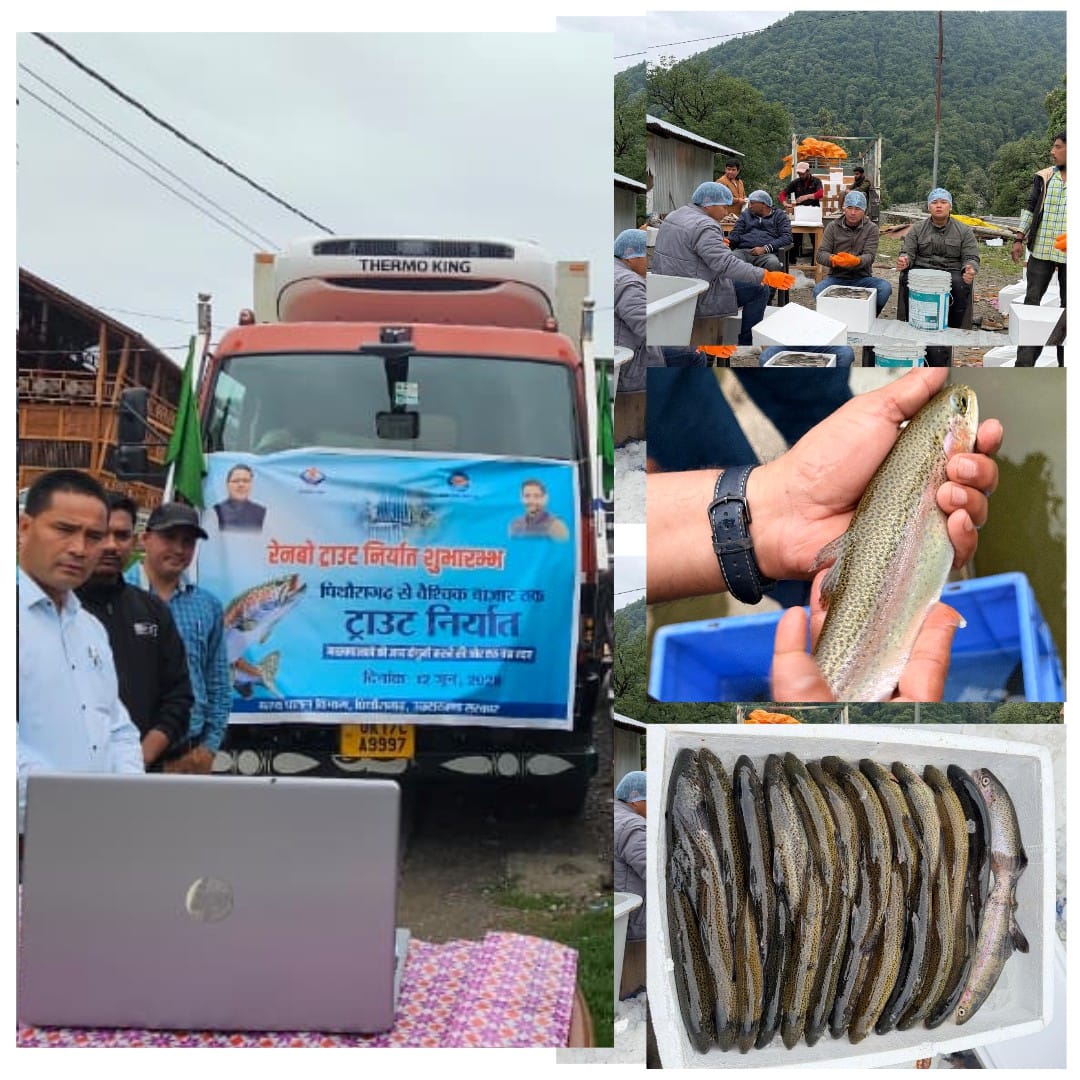
One of the biggest achievements has been the regular supply of fresh trout to the Indo-Tibetan Border Police (ITBP). Through more than 25 fisheries cooperative societies across 8 districts, more than 50 metric tonnes of fresh trout, worth around have been supplied to ITBP posts in the state. This has created a dependable institutional market for fish farmers while demonstrating how cold-chain infrastructure and strong cooperative networks can successfully connect remote Himalayan producers with large buyers.
The success of this system is now reaching beyond Uttarakhand. Using a refrigerated vehicle under the scheme, fresh trout harvested in a remote border village of Pithoragarh was transported through the processing centre at Veraval, Gujarat, and exported to Nepal, maintaining an uninterrupted cold chain over a journey of nearly 4,000 kilometres. This milestone has shown that even fish produced in the state's most remote hill villages can now reach distant markets while retaining quality and freshness.
From Potential to Prosperity
PMMSY has transformed fish marketing in Uttarakhand from a major challenge into a strong pillar of the state's fisheries sector. By creating an integrated marketing network of cold-chain transport, fish kiosks, modern markets and institutional linkages, the scheme has connected fish farmers in remote villages with consumers, institutional buyers and even international markets.
Today, farmers can sell their harvest with confidence, benefiting from reduced post-harvest losses, better prices and reliable market access, while consumers receive fresh, hygienically handled fish. By bridging the gap between production and markets, PMMSY has strengthened rural livelihoods and laid a strong foundation for sustainable fish farming in Uttarakhand.